Glider Launch Procedures
Moriarty Traffic: 122.9 Moriarty AWOS: 118.05 Field Elevation: 6204' MSL
This is a brief guide to glider launch procedures at Moriarty.
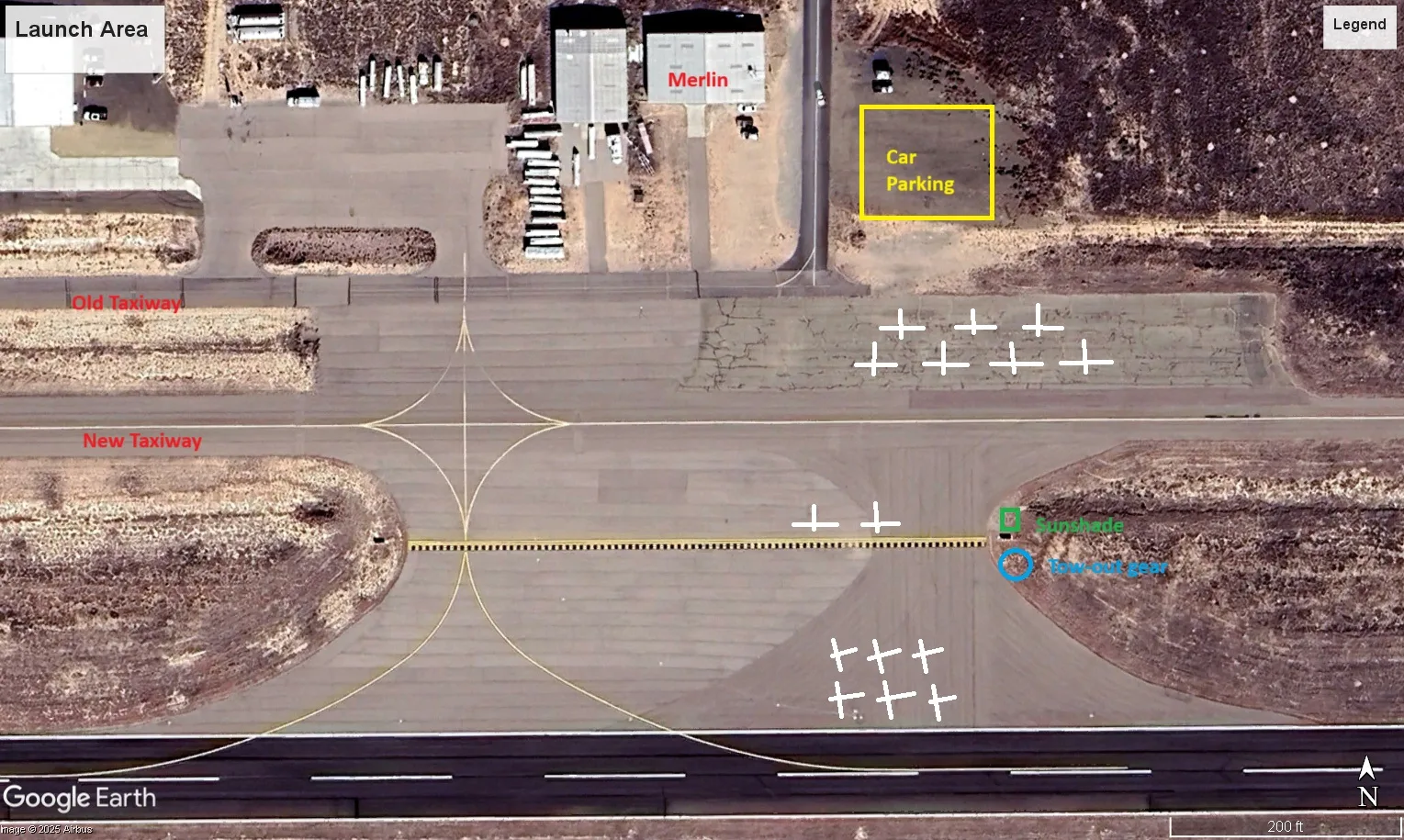
Moriarty airport has grown considerably in recent years and now has more powered aircraft based here than gliders. Accordingly, we try to minimize the disruption to normal airport operations. Fortunately we have an excellent place to conduct glider operations just off the main runway. Ramp Delta was specifically designed for this purpose. The photo above shows this area.
We favor launching on Runway 26 because it gives us over 4500ft of pavement, and there are decent emergency options to the west of the runway (see Tow Emergency (PTT) Options). Launching on 8 gives barely 3000ft and the terrain to the east is dreadful – very rough, sloping considerably down to a wide gully, then rising on the other side to a level well above the runway. So we will accept several knots of tailwind component to use 26. We will also tolerate a fair crosswind component. Runway 17-35 is difficult to launch from as there really isn’t room to stage more than a few gliders. An expanded ramp area here is in planning but not on the ground yet.
So, looking at the overhead photo of Ramp Delta, our cartoon figure gliders show how we set up for launch on a non-contest day. Pilots often stage their gliders early in the day at the tie-down area north of the taxiway (which is reserved for gliders) and leave their vehicle in the yellow-marked parking area. Please park at least 25ft from the edge of the north-south taxiway as gliders and airplanes will be passing through here. When gliders are ready for launch, they’ll move up next to the runway. On a weekend, when both the Albuquerque Soaring Club and Merlin towplanes are operating, we may use two launch lines, one for each towplane. On a weekday typically it will be a single line. The first ship in line will be parked next to the cluster of recessed landing lights you can see next to the runway. Up to two additional gliders may stage behind them; this leaves room for landing gliders to pull off the runway behind the launch line. If additional ships are ready, they can pull up just before the hold-short line. We like to limit this to two because we need to keep room to the east for landing gliders to move through, room to the west for the towplane(s), and room to the north for aircraft using the taxiway. When the first glider in the launch line takes off, the remaining two move forward, and the next glider at the hold-short will move to the end of that line. Typically you’ll keep your tow-out gear on until you get into the launch line, then take your dolly and wing wheel over to the blue-marked area on the East side of the ramp.
For a contest launch, all gliders will be gridded on the ramp next to the runway in marked positions, in two or possibly three rows. The airport manager will close runway 8/26 prior to the grid opening, so pilots can maneuver on the runway to get in place. Tow-out gear will again go in the blue-marked area, and vehicles in the parking area.
Some last notes about this area: during a contest, we’ll have a sunshade tarp set up next to the launch area with some chairs and a cooler or two. Help yourself, stay hydrated. There will be a porta-potty next to the car parking area. Finally, note the taxiways marked ‘Old’ and ‘New’. This photo was taken before the old taxiway was resurfaced, and it was truly rough – you could literally see the expansion joints from outer space. It has now been repaved; it’s still narrower than the new taxiway, but if you can use it without dragging a wheel through the grass you’ll be fine.